 Bedroom
 Coffee Tables
 Dining Tables
 Garden Decor
 Living Room
 Painting Art
 Wall Art

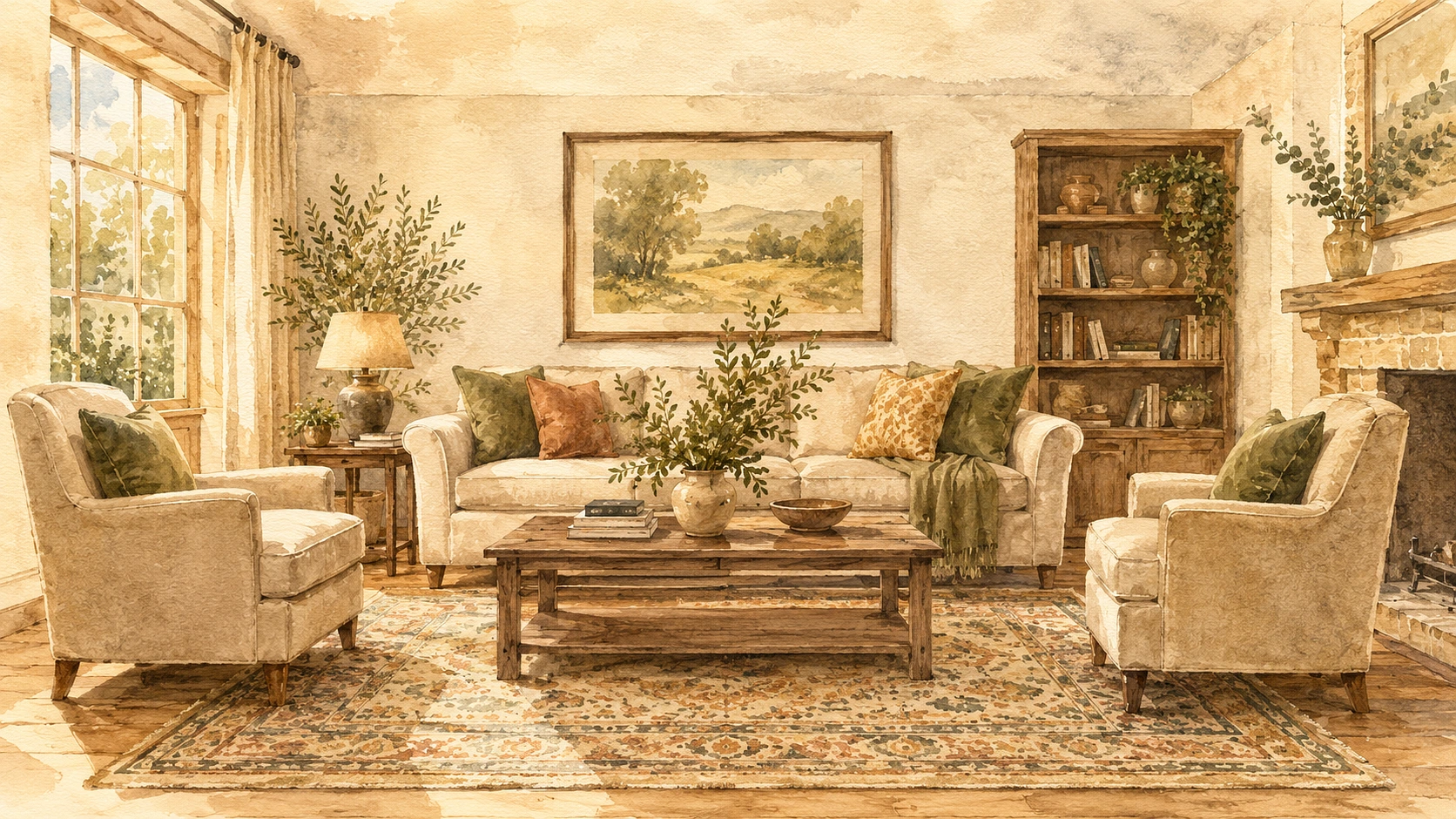
For about two years, I thought there was something wrong with my living room.
I moved the sofa. Twice. I tried the armchair in three different corners. I convinced myself the window was badly placed, that the room was an awkward shape, that whoever built the place had got the proportions slightly wrong somehow. I looked at paint colours. I genuinely considered moving a bookshelf into a different room entirely, just to see whether that would fix whatever was bothering me.
It was the rug. The rug had been too small the entire time.
Everything Was Floating
Here is what a too-small rug actually does, and why it took me so long to see it.
The furniture stops relating to itself. Sofa over here, armchair over there, and a small island of rug marooned in the middle underneath the coffee table, touching nothing. Each piece becomes its own separate thing stranded on bare floor. Nothing looks connected because nothing is connected, and your eye reads that as the room being wrong rather than the rug being wrong.
That’s the trap. The rug is the one thing you are least likely to blame, because it is the thing you look at least. You look at the sofa. You look at the walls. The rug is just the floor, and floors don’t have opinions.
The Rule I Wish Somebody Had Told Me
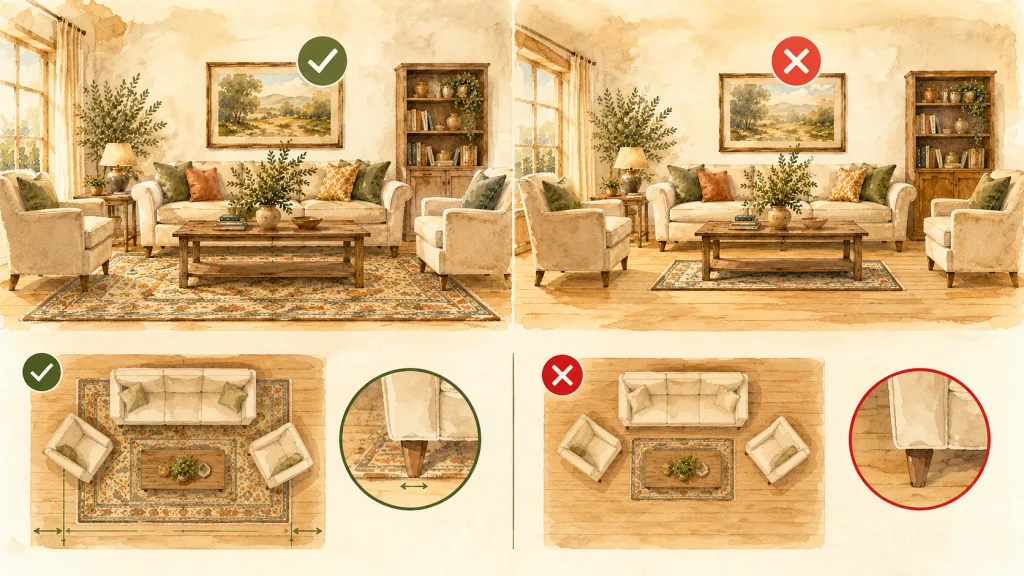
At minimum, the front legs of your sofa should be sitting on the rug.
That’s it. That’s the whole thing. Front legs on, back legs hanging off onto the floor. That is not a compromise, incidentally; it is a recognised standard, and the same applies to your armchairs. Get the front legs on, and suddenly all those separate pieces are standing on the same surface, reading as one seating area rather than several bits of home furniture that happen to share a room.
Ideally, you want six to eight inches of rug showing beyond those front legs, so the whole thing looks deliberate instead of as though the rug only just made it.
The version I had been doing, and I suspect most people do, is buying a rug to sit in the gap between the furniture. Like a coffee table mat. That is not what a rug is for.
It’s Almost Always Bigger Than You Think
When I finally worked this out and went to buy a replacement, my instinct was still wrong. I stood in the shop looking at what felt like an enormous rug, thinking that surely could not be right, that it would swallow the room whole.
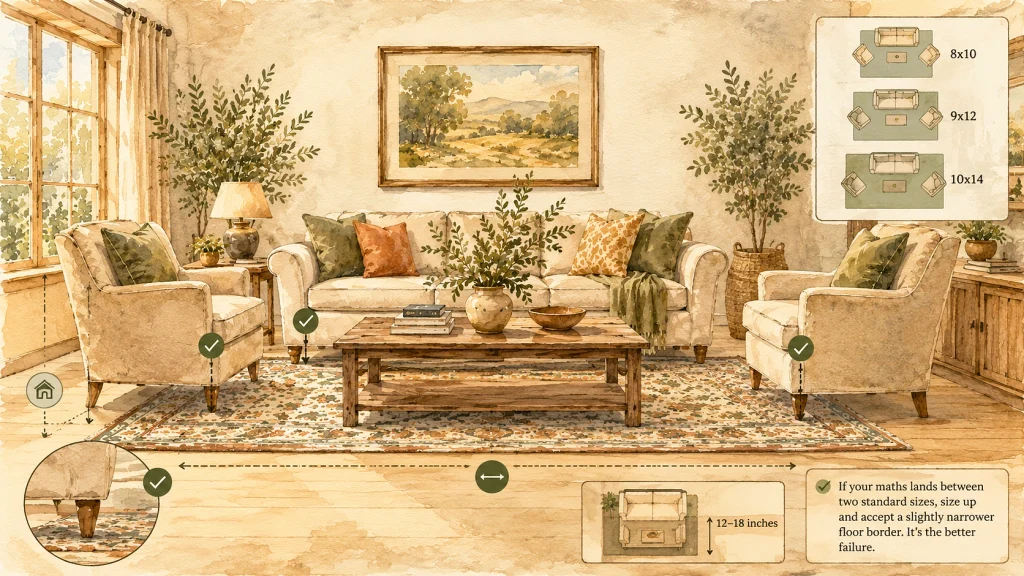
For most living rooms, you are looking at one of these:
- 8×10 – the safe default for a medium room with a standard sofa and a chair or two.
- 9×12 – where to start if your sofa is wider than roughly 90 inches, or the room is generous.
- 10×14 – for sectionals and open-plan spaces, where anything smaller leaves half the seating stranded.
The 5×7 or 6×9 that feels like a sensible, proportionate, not-overdoing-it choice is precisely the one that will leave everything floating.
And if you are stuck between two sizes, take the bigger one. A slightly-too-large rug reads as a design decision. A too-small one just reads as a mistake, which, in fairness, is exactly what mine was.
Measure First; It Takes Five Minutes
I bought my first rug by eye and paid for it with two years of vague dissatisfaction, so learn from that rather than repeating it.
Before you order anything:
- Arrange the furniture where you actually want it. Not where it currently sits.
- Measure the full footprint of the seating group sofa, armchairs, everything in the arrangement. Measure the furniture, not the room. That distinction matters more than it sounds, and getting it backwards is how people end up with a rug that fits the space but not the sofa.
- Check the front legs land on it. Every piece in the group, not just the sofa.
- Leave 12 to 18 inches of bare floor between the rug edge and the walls. That visible border is what stops a large rug feeling like wall-to-wall carpet, and it does something slightly counterintuitive the gap makes the room look wider, not narrower.
If your maths lands between two standard sizes, size up and accept a slightly narrower floor border. It’s the better failure.
If You Have Already Got A Rug You Like
This was my other worry. I actually liked my too-small rug. I just needed it to be bigger, which is not a thing rugs do.
The fix is layering. Put a large natural-fibre rug underneath, jute or sisal, sized properly for the room, then lay your existing one on top of it. The big one does the structural work of connecting the furniture, the one you like stays visible, and the combination looks intentional rather than as though you are covering something up.
What does not work is two similar rugs pushed together to cover more ground. I have watched this attempted. It reads exactly as what it is.
The Bit That Actually Annoyed Me
Once I had fixed it, the room I had spent two years mildly disliking became the room I had wanted all along. Same sofa. Same walls. Same window I had blamed. Same allegedly awkward proportions.
That is the frustrating part, and it is why I mention it to anyone who tells me their living room feels a bit off. Before you repaint, before you rearrange for the fourth time, before you start resenting your own floor plan, go and look at the rug and check whether your furniture is actually standing on it.
Measure the space. Buy the bigger one. It is an unglamorous fix for a problem that feels far more complicated than it is.