 Bedroom
 Coffee Tables
 Dining Tables
 Garden Decor
 Living Room
 Painting Art
 Wall Art


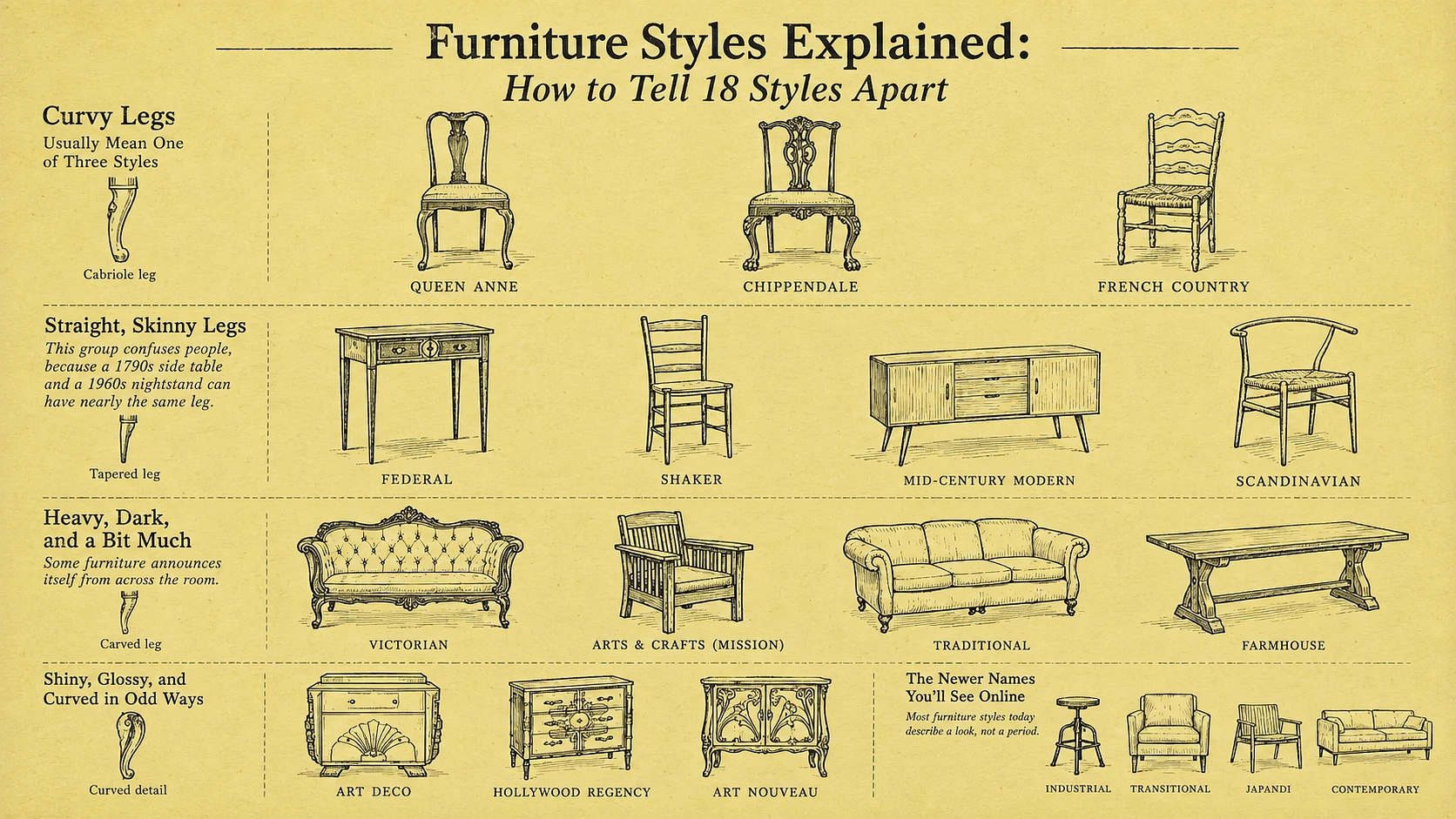
The quickest way I know to figure out a furniture style is to ignore the overall look and stare at the legs for a second. Then pull a drawer out. The legs usually tell you the family, and the drawer tells you whether the piece really belongs to it or is wearing a costume.
I’ve grouped the 18 styles below by what you notice first, not by date. Nobody walks into a thrift store thinking in centuries. If you’re looking at a piece right now and wondering what style of home furniture it is, start with the section that matches its legs.
Curvy Legs Usually Mean One of Three Styles
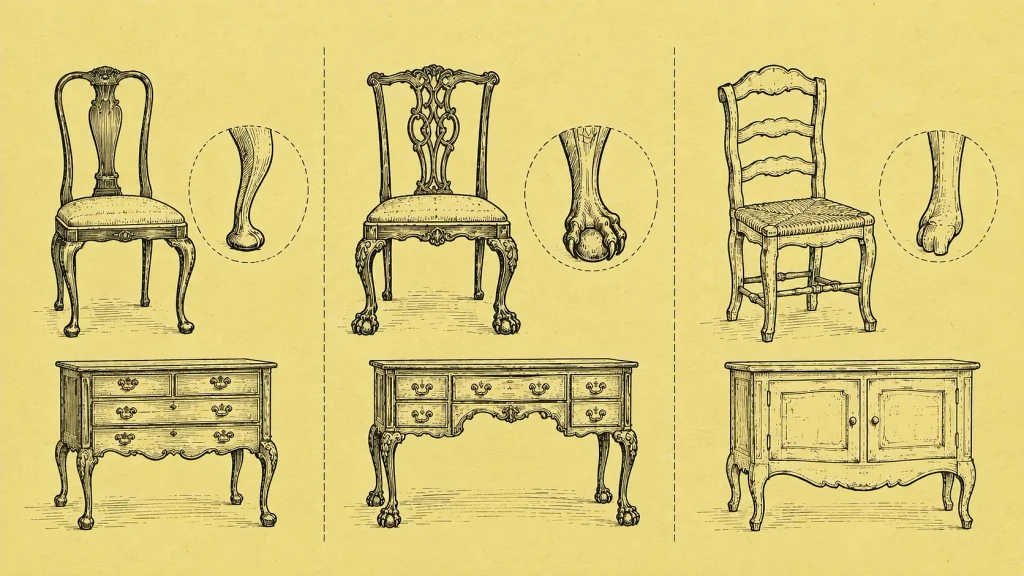
A leg that swells out at the knee and pinches in at the ankle is called a cabriole leg. If you see one, you’re almost always looking at Queen Anne, Chippendale, or French Country.
Queen Anne
Plain feet. That’s more or less the whole difference from Chippendale. Queen Anne legs end in a smooth, rounded pad foot, and the chair backs have a single vase-shaped panel down the middle. Most American pieces are walnut or cherry from about 1720 to 1760, which is funny when you think about it, since Queen Anne died in 1714 and never saw any of it.
Reproductions are everywhere. I bought one I was sure about (it cost me $140, which felt like a steal for maybe ten minutes) and then found Phillips-head screws holding the drawer runners. Those didn’t show up in furniture until the late 1930s at the earliest. I still don’t know exactly when it was made. The ’70s? The ’80s? Either way, it sits next to my bed now.
Chippendale
Same curvy leg, but the foot is a carved claw gripping a ball. Chippendale is fussier all over, with pierced chair backs, carved knees, and a lot of mahogany. In America, the best of it came out of Philadelphia and Newport, Rhode Island, and a documented Newport piece can sell for more than a house. You won’t find one at a yard sale. You might find a 1920s Chippendale revival dining set, though, and those are nice in their own right.
French Country
This one is softer and more rustic than the other two. The curves are still there, but the finish is painted and worn at the edges, and the seats are often rush or cane. It’s less a period than a countryside take on fancy French furniture, and plenty of it is brand new.
Straight, Skinny Legs
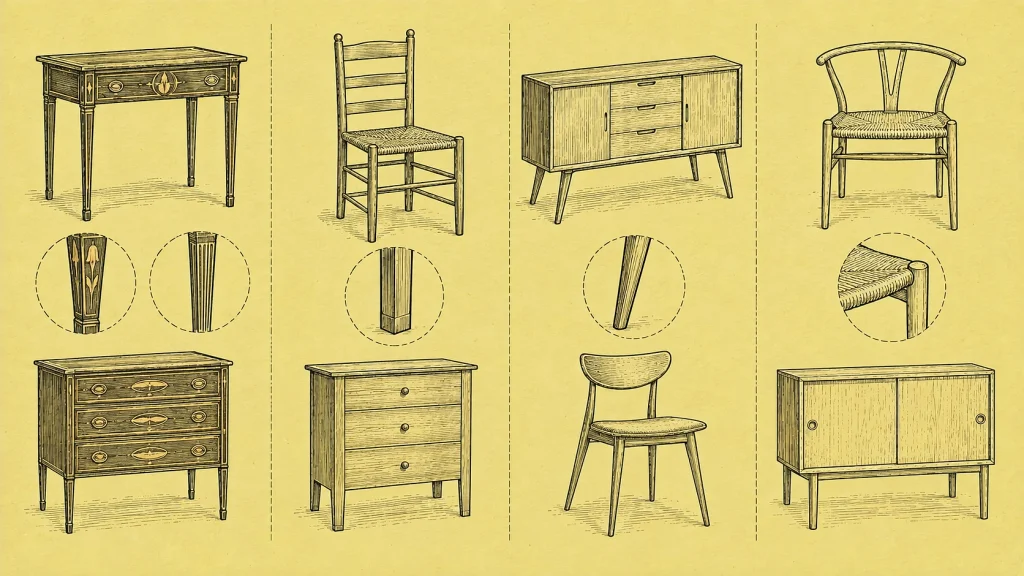
This group confuses people, because a 1790s side table and a 1960s nightstand can have nearly the same leg.
Federal furniture, from roughly 1780 to 1820, is the old one. The legs taper toward the floor, sometimes square and sometimes round with fine grooves. Look closely at the surface. Federal makers loved inlay, meaning thin strips or tiny bellflower shapes in a lighter wood set into mahogany.
Shaker pieces have straight legs too, but nothing else. There’s no inlay, no carving, and no fancy pulls, only small wooden knobs. The Shaker chair shop at Mount Lebanon, New York, marked its chairs with size numbers from 0 to 7, and many carried a gold trademark decal. I’ve never found a real one. I’ve probably checked forty.
Mid-Century Modern legs are skinny and tapered like Federal ones, but they splay outward at an angle. The wood is usually walnut or teak. Thrift stores are full of Broyhill Brasilia and Lane pieces from the ’60s, and those are genuinely mid-century, even without a designer name attached.
Pull the drawer on anything that looks mid-century. A friend's "mid-century" dresser had staples, particleboard, and a veneer you could peel with a fingernail. It had a nice shape, though. It was probably 10 years old.Scandinavian is the paler cousin, made in beech, ash, birch, and light oak. Seats are often woven paper cord, which goes loose and saggy after a few decades. A saggy cord seat is honestly a decent sign of age.
Heavy, Dark, and a Bit Much
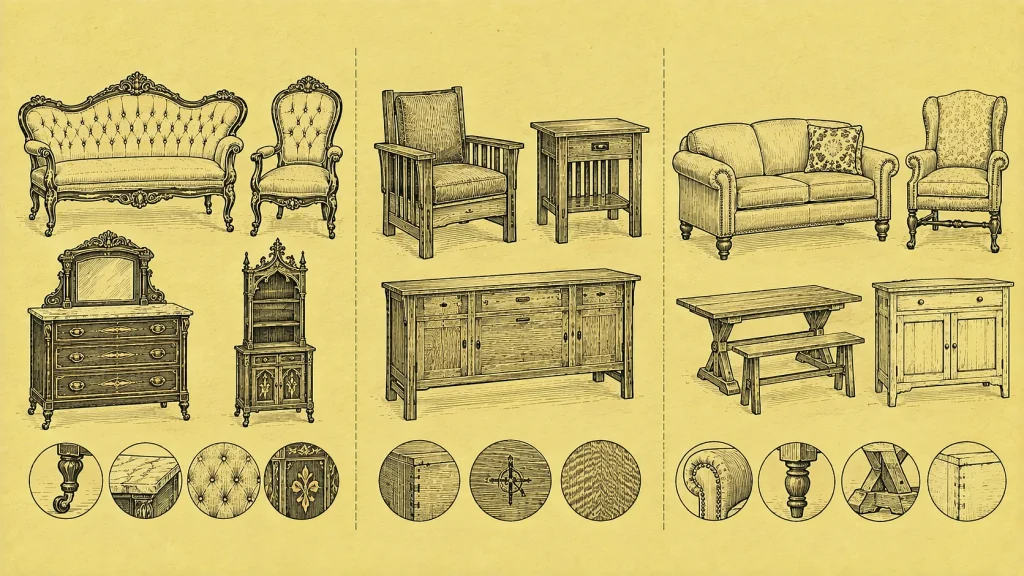
Some furniture announces itself from across the room.
Victorian
If a piece looks heavy before you even lift it, start here. Victorian covers 1837 to 1901, so it includes several looks: carved Rococo Revival parlor sets, pointy Gothic Revival pieces, and the flatter Eastlake style, which has lines cut into the wood instead of deep carving. Most Victorian pieces share a few features:
- dark walnut or mahogany, often with swirly burl veneer.
- marble tops on dressers and side tables.
- deep, button-tufted upholstery.
- small wheels, called casters, on chair and sofa legs.
Arts and Crafts (Mission)
Mission furniture is heavy too, but square instead of curly. It’s usually quartersawn oak, which has a wavy, flickering pattern across the grain, and you can often see the joints poking right through the sides. Gustav Stickley’s workshop marked many of its pieces with a joiner’s compass and the motto “Als ik kan.” If you ever spot that mark, stop and take photos.
Traditional and Farmhouse
These two are store labels more than history. Traditional borrows from 18th- and 19th-century English designs, with rolled arms, matching pairs, and dark stain. Farmhouse means chunky painted wood, trestle dining tables, and benches. I like farmhouse tables for one boring reason: kids can’t really hurt them.
Shiny, Glossy, and Curved in Odd Ways
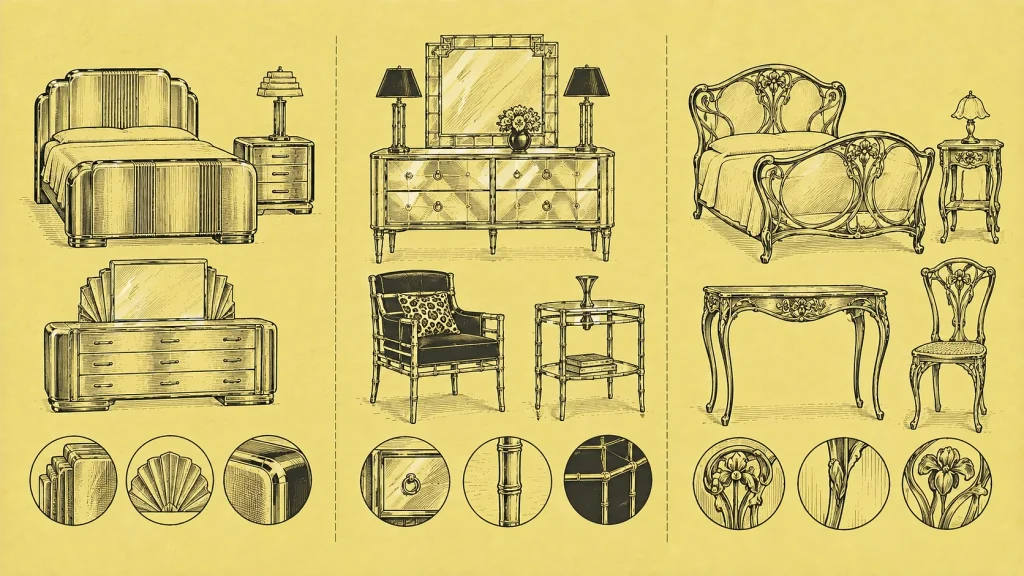
Art Deco is all geometry stepped edges, fan and sunburst shapes, glossy lacquer, and chrome. The version most people actually own is the 1930s or ’40s waterfall bedroom set, where the top edges roll down in a rounded curve. They show up at estate sales constantly and usually sell cheap.
Hollywood Regency is Deco’s showier relative. Expect mirrored drawer fronts, brass, black or emerald lacquer, and fake bamboo legs. It’s supposed to look a little over the top.
Art Nouveau came earlier, from about 1890 to 1910, and it curves like a plant, with stems and leaves carved right into the frame. Real pieces are mostly French, from makers like Louis Majorelle in Nancy, and they’re rare. I’ve seen exactly one outside a museum.
The Newer Names You’ll See Online
Most furniture styles on shop websites today describe a look, not a period.
- Industrial mixes black steel with rough or reclaimed wood, and it started with actual factory stools and work tables.
- Transitional sits halfway between traditional and contemporary: familiar shapes, fewer details, and a lot of beige.
- Japandi blends Japanese and Scandinavian design into low, quiet pieces in natural wood.
Contemporary means whatever is being made now, so it keeps changing. People mix it up with “modern” all the time, but modern is a period, roughly the early to mid-1900s. A 1962 walnut credenza is modern. The sofa you ordered last month is contemporary, even if it looks like 1962.
Most pieces you find won’t fit one style cleanly anyway. Anything made after about 1990 usually borrows from two or three at once, and the store picks whichever name sells better that year.