 Bedroom
 Coffee Tables
 Dining Tables
 Garden Decor
 Living Room
 Painting Art
 Wall Art



There’s no official answer key for the Making an Offer lesson in Framework’s homebuyer course. The pages ranking for this search mostly repeat the phrase “making an offer answers” without giving real ones. What you can do is learn the handful of ideas the offer questions are built on, and once those make sense, the quiz answers itself.
Below is what Framework is, why the certificate matters more than people think, and the offer concepts worth knowing before you click “next.”
I Went Looking for the Answer Key First
Honestly, that’s where I started too. I opened the top results for this exact search one after another. Most were long pages that never showed a single real question. A few talked about “frameworks” as if the course were a piece of software. None came from Framework itself.
That tells you something. Even if a list of answers were floating around, question banks change, and a copied answer to a reworded question is only a coin flip. The bigger problem is what the certificate is for.
What Framework Is and Why the Certificate Matters
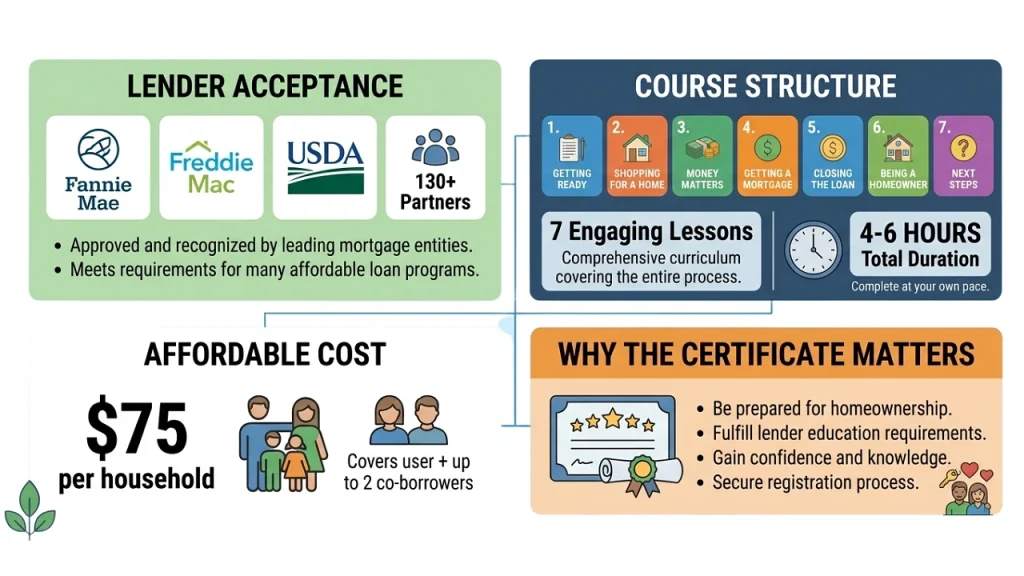
Framework Homebuyer Education is an online course that, according to Framework, is accepted by Fannie Mae, Freddie Mac, USDA, and more than 130 partners. It’s made up of seven lessons, and most people finish in four to six hours. The course costs $75 per household, which covers you and up to two co-borrowers.
Many down payment assistance programs and first-time buyer loans require that certificate. Some local agencies add a live follow-up session on top of the online course, and they only issue the certificate after both parts are done. One Massachusetts program, for example, charges $25 for that session and says its certificate is good for three years.
So the lesson isn’t busywork. It’s standing between you and money for your down payment, and the offer stage is where buyers lose the most when they don’t understand what they’re signing.
The Ideas Behind the Making an Offer Questions
I haven’t seen Framework’s actual quiz questions, and I won’t pretend otherwise. Offer lessons in homebuyer courses almost always come back to the same few concepts, though.
Offer Price and Comps
Your offer price should come from comparable sales, recent sales of similar homes nearby, not from the asking price alone. Your agent pulls these. If the question asks what determines a fair offer, the answer almost always involves comps and market conditions, not what you “feel” the house is worth.
Earnest Money
Earnest money is a good-faith deposit you put down when your offer is accepted. It’s usually held in escrow by a third party, not paid to the seller directly, and it goes toward your down payment or closing costs at closing. You can lose it if you back out for a reason your contract doesn’t protect.
Contingencies
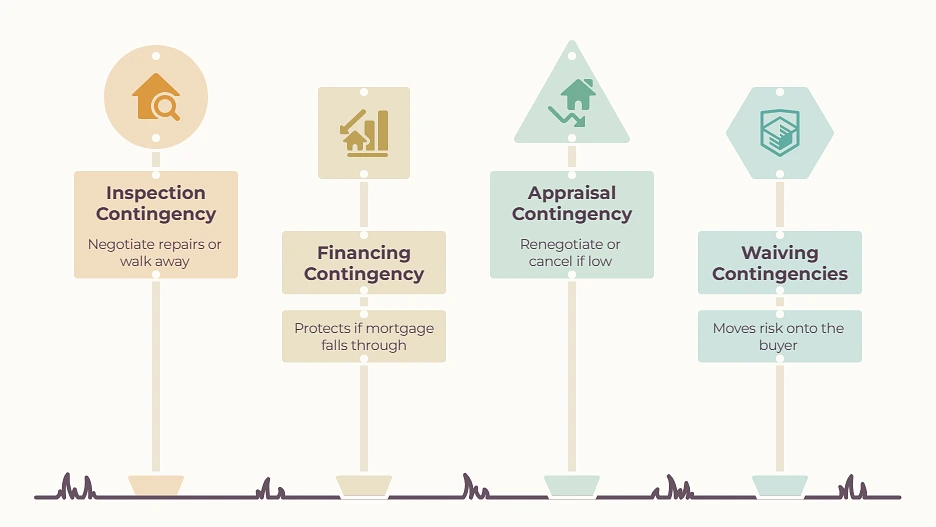
A contingency is a condition that has to be met, or the deal can be canceled without losing your earnest money. The common ones:
- inspection contingency, which lets you negotiate repairs or walk away if the inspection finds serious problems
- the financing contingency, protecting you if your mortgage falls through.
- an appraisal contingency for when the home appraises for less than your offer price, so you can renegotiate or cancel instead of covering the gap yourself.
Waiving contingencies makes an offer look stronger to a seller. It also moves the risk onto you, which is the kind of trade-off these lessons like to test.
Counteroffers and Acceptance
When a seller changes anything in your offer, like the price, the closing date, or who pays which cost, that’s a counteroffer. It isn’t an acceptance. It’s a brand-new offer, and your original one is off the table. The back-and-forth continues until one side accepts the other’s terms without changes.
Once both sides sign, the purchase agreement becomes a binding contract. From then on, your contingencies and deadlines are what protect you.
A Quick Example
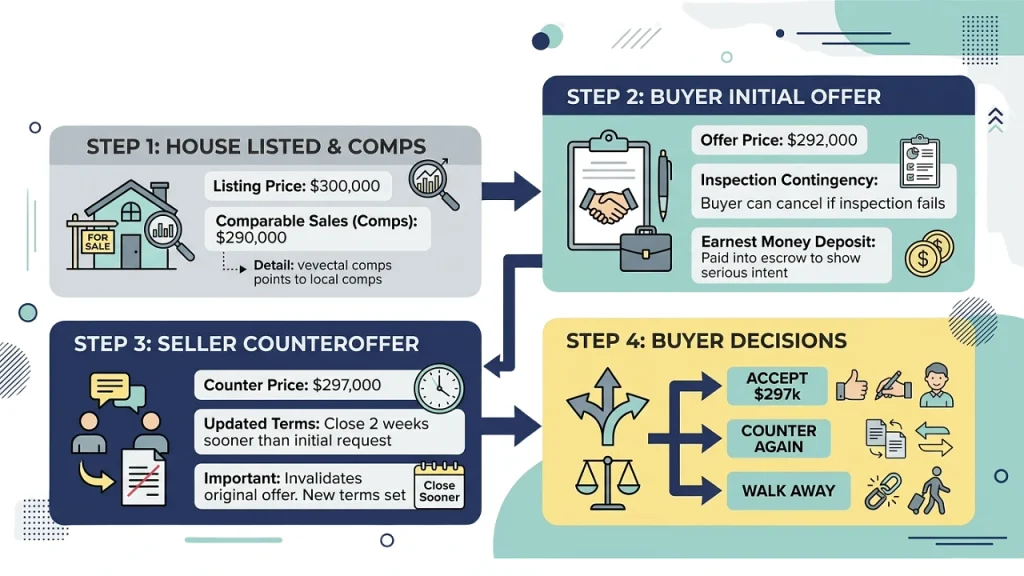
Say a house is listed at $300,000, and similar homes nearby sold for around $290,000. You offer $292,000 with an inspection contingency and put down earnest money. The seller replies at $297,000 and asks to close two weeks sooner. That reply is a counteroffer, so your $292,000 offer no longer exists. You can accept the $297,000, counter again, or walk away.
If you can follow that example without guessing, you can handle most of what an offer lesson throws at you.
How to Get Through the Lesson Without Guessing
A few things that make it easier:
- Take notes on the terms, especially earnest money, the contingencies, and counteroffers, since those overlap with later lessons.
- go back through any section you rushed. Framework says your registration doesn’t expire, so the course stays available after you finish.
- save your questions for the follow-up session if your program has one, because a housing counselor can answer them with local rules in mind.
The offer lesson looks like the boring part of a boring course, but it isn’t. It’s the only part that describes a contract with your money in it. Spend the twenty minutes learning it properly, because the real test comes later, across a kitchen table with a pen in your hand.