 Bedroom
 Coffee Tables
 Dining Tables
 Garden Decor
 Living Room
 Painting Art
 Wall Art

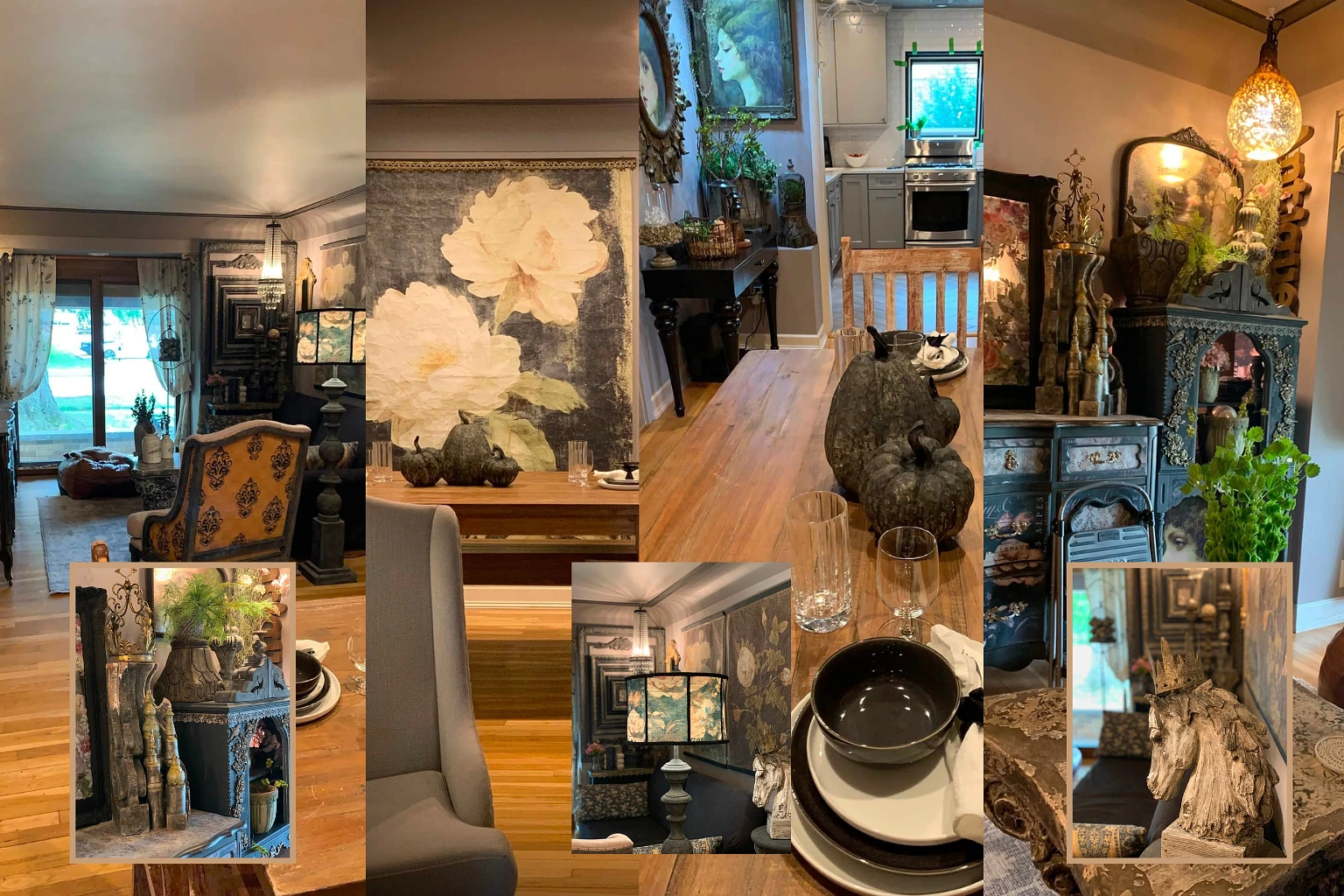
A reader shared photos of the ranch house she has spent months working on, almost all of it built from things bought used, given to her, or picked up cheap and then changed until they suited her.
Her question at the end was simple, can anybody relate?Plenty of people can. What’s more useful is looking at what she actually did, because the rooms in those photos are not the result of good luck at thrift stores. There are four or five specific techniques at work, and the reason the rooms read as curated rather than cluttered comes down to decisions that can be copied.
The Painted Buffet Is Doing Three Separate Things
The blue-grey sideboard is the centrepiece of the whole scheme, and there are at least three techniques layered onto that one piece.
Chalk Or Mineral Paint As The Base
This is almost certainly what’s underneath everything else. It’s the standard route for furniture upcycling for one reason: it requires no priming and little to no sanding on most pieces, which removes the step that stops people starting. It goes over old varnish, over laminate, over metal.
Furniture Transfers For The Imagery
The roses and the French script reading Les Alpes and Grenoble are rub-on decals. You position the sheet and burnish the back with a stick until the design releases onto the surface.
Three things worth knowing before your first one:
- They’re opaque, so they work over dark paint, not just pale colours
- Wax softens the edge. Rubbing furniture wax over a finished transfer removes the faint line you can otherwise feel with a fingertip
- 220-grit paper distresses them. Used gently, it makes the design look aged into the piece rather than stuck onto it
Rice Paper Decoupage For The Larger Areas
The marbled top is decoupage. Rice paper is the usual recommendation for a first attempt because it tears softly and hides its own seams.
- Apply it with a clear sealer or decoupage medium, not ordinary glue.
- Let it dry completely before touching the edges.
- Then hold a sanding block at an angle and sand the excess away, rather than trying to trim it neatly while wet.
The tall cabinet beside it carries a portrait transfer on the lower panel and applied resin mouldings around the arch, painted over so they read as carved rather than glued on. That’s a cheap silicone mould and a tube of adhesive doing the work of an antique.
Know What You’re Sanding Before You Sand It
Furniture painted before 1978 may carry lead paint. Sanding it releases lead dust, which is dangerous to breathe and considerably more dangerous around children and pregnant women. The EPA’s guidance on lead in the home covers how to identify it and how to work around it safely.
What that means when you bring home a piece with an unknown history:
- Test first. Lead test kits cost a few dollars at any hardware store.
- Skip dry sanding entirely if you’re unsure, particularly indoors.
- Use wet distressing instead. A damp cloth rubbed over paint while it’s still soft gives the same worn look with no dust, and more control over how much comes off.
- Chemical strippers and liquid deglossers remove the sanding step altogether.
None of this is a reason to avoid old furniture. It’s a reason not to stand over an orbital sander in a closed room without knowing what’s on the piece.
Salvage Becomes Sculpture When You Group It
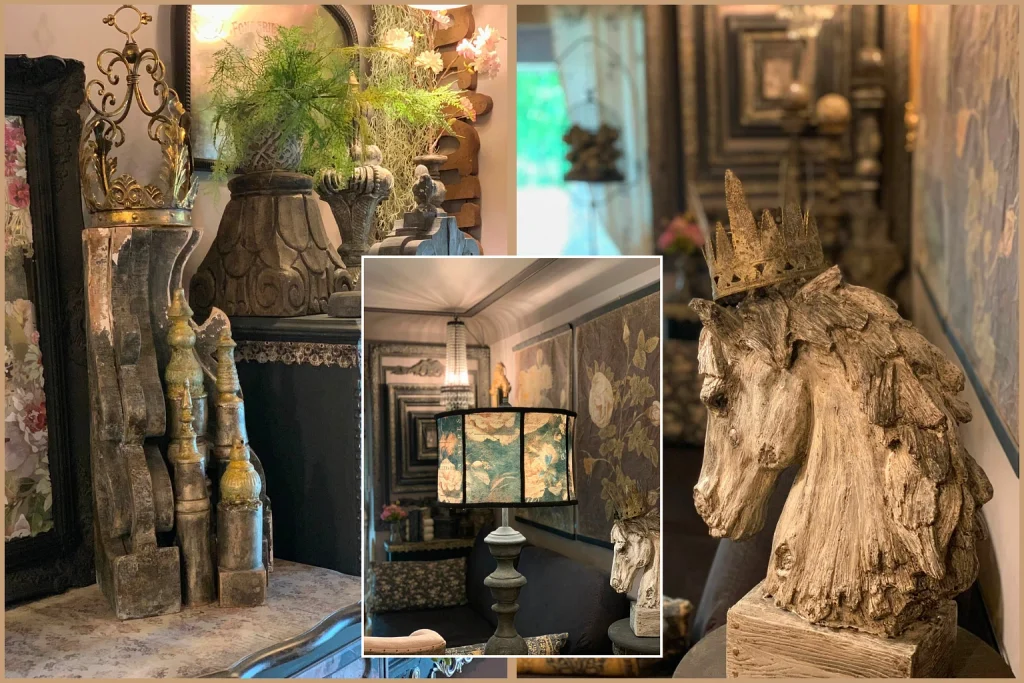
The finials, balusters and corbels arranged across the top of the sideboard are, individually, architectural scrap. Bits of staircase, fragments of porch column, offcuts of moulding.
Grouping is what turns them into decor. A single baluster on a shelf reads as a leftover. Nine of them at varying heights read as a collection, and the eye stops asking what each piece is and starts seeing the arrangement instead. The same principle carries the driftwood horse head wearing a rusted crown, which becomes deliberate the moment it’s given a plinth and a position.
Where this material comes from cheaply:
- Architectural salvage yards, sold by the piece.
- Demolition and estate sales.
- Habitat for Humanity ReStores, where this is stock they struggle to move.
The Art Is Large And Almost Certainly Cheap
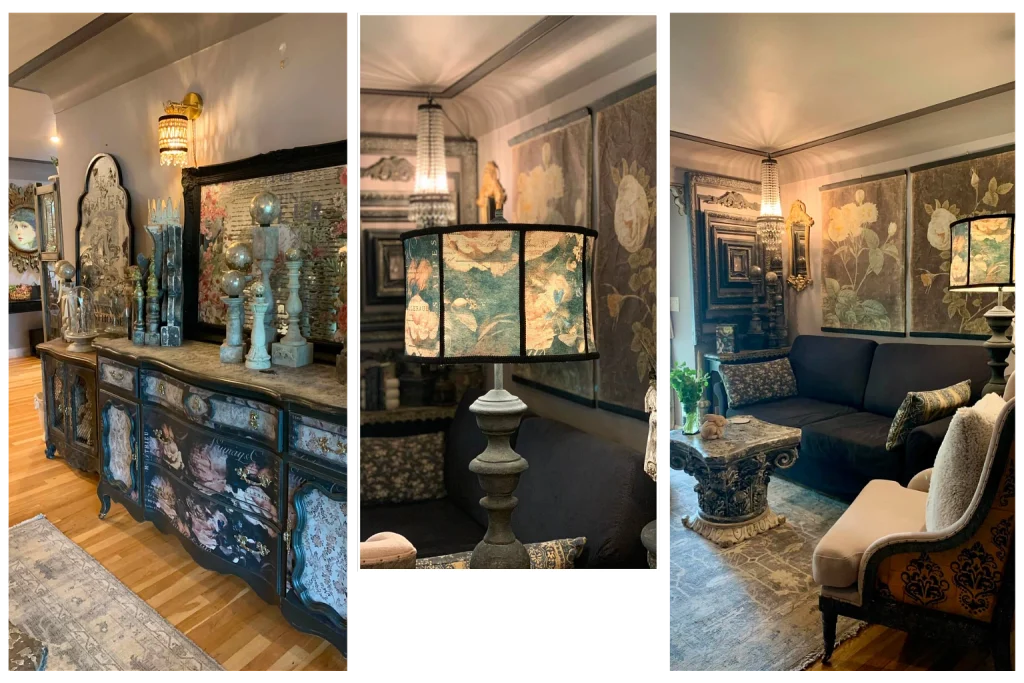
The floral panels behind her sofa and the peony canvas in the dining room are the two biggest visual moves in the house, and large-scale art is normally the most expensive thing in a room.
These have the look of painted or printed canvas hung from a rod rather than framed, which is the entire trick. A framed 30 by 40 inch print runs into the hundreds. An unframed canvas or a painted drop cloth hung from a length of moulding costs a fraction of that, and at that scale nobody is examining the mounting.
The dining room piece hangs from a decorative rod like a tapestry, which also solves the problem of fixing heavy art to plaster. Buying rather than making works the same way, provided you hang oversized wall art unframed and hang it big. Scale is doing more work here than the image is.
Why It Reads As Curated Rather Than Cluttered
This is the real question, because most people who fill a room with vintage finds end up with something resembling a storage unit.
Three things separate her rooms from that:
- The palette is tightly limited. Across every photo the same colours repeat: blue-grey, cream, weathered gold, and green from the ferns. Dozens of objects, four colours. That repetition is what lets a maximalist room feel intentional, because the eye reads the colour relationship before it counts the objects.
- The walls stay plain. Behind all that ornament, flat taupe and cream. Ornate objects need a quiet background or nothing has anywhere to rest, and wallpaper behind those pieces would collapse the whole scheme.
- Objects are grouped by form rather than scattered. All the finials together, all the mirrors on one wall. That creates deliberate density in some spots and genuine emptiness in others, and the contrast is what stops it reading as accumulation.